
Post ACL Reconstruction Rehabilitation
Specialist Rehabilitation in Gosport, Emsworth and Clanfield
Book your knee specialist appointment onlineACL reconstruction is often seen as the moment the knee is fixed.
In reality, surgery is only one part of the process.
The operation reconstructs the ligament. It does not automatically restore full movement, rebuild strength, normalise landing mechanics or return confidence in cutting and pivoting. Rehabilitation determines how well the knee functions afterwards.
At Solent Specialist Physiotherapy, post ACL reconstruction rehabilitation is managed within our specialist knee service by NHS level Band 8a physiotherapists with extensive experience in complex knee conditions and post-operative recovery. Within our Gosport, Emsworth and Clanfield clinic, post ACL reconstruction rehabilitation forms an important part of this service. We work with active individuals, recreational athletes and returning sportspeople who want more than a standard exercise sheet. Our approach is structured, stage-appropriate and focused on restoring a knee that feels strong, stable and trustworthy again.
What Surgery Changes — and What It Doesn’t
ACL reconstruction is designed to restore mechanical stability to a knee that has become unstable following rupture of the anterior cruciate ligament.
For many people, this is an important part of returning to sport or higher-level activity. But surgery does not erase the effects of the original injury.
The knee is often swollen, stiff and inhibited after surgery. Quadriceps strength is reduced. Proprioception is altered. Single-leg control is usually poor in the early stages. If there has also been associated meniscal injury or cartilage damage, recovery can be more complex still.
The graft may be in place. The whole limb still needs retraining.
Understanding this early is important. It helps explain why the knee may feel weak or awkward even when the surgery itself has gone well.
The Early Recovery Period
In the first phase after ACL reconstruction, the priority is not intensity. It is quality.
Early rehabilitation focuses on settling swelling, restoring full knee extension, gradually improving flexion, reactivating the quadriceps and establishing a more normal walking pattern. These foundations matter. If the knee remains swollen and flexed, gait becomes compensatory, muscle activation lags behind and later progress often becomes harder.
This stage is also where frustration often begins. Many patients are surprised by how difficult it can be to fully straighten the knee, contract the quadriceps confidently or walk without a sense of heaviness.
That is normal.
The aim early on is not to rush. It is to establish the right building blocks for what comes next.
Why Full Extension Matters So Much
One of the most important early goals after ACL reconstruction is restoring full knee extension.
Patients often focus naturally on bending the knee, but a loss of extension can be even more significant. A knee that does not fully straighten tends to walk poorly, load poorly and feel mechanically wrong. It can also interfere with quadriceps recovery and make the knee feel much less functional than expected.
In practice, a knee that bends reasonably well but does not fully straighten is often the knee that continues to feel disappointing.
This is why early rehabilitation pays such close attention to extension. It is not a minor detail. It is central to how the knee will function.
Swelling, Stiffness and the “Heavy Knee”
Swelling is one of the main reasons the knee feels unresponsive after ACL reconstruction.
A swollen knee often feels tight, heavy and difficult to activate. It does not bend or straighten as easily, and the quadriceps frequently fail to contract properly when swelling remains prominent. This is one reason why the knee can feel far weaker than patients expect, even when pain is not severe.
Some stiffness is expected after surgery, particularly in the early weeks. But progress should still be moving in the right direction. A knee that remains very reactive, persistently swollen or unexpectedly stiff needs careful review rather than simple reassurance.
Managing the swollen knee well is not just about comfort. It is about creating the conditions for movement and strength to recover properly.
Rebuilding Strength After ACL Reconstruction
Strength recovery after ACL reconstruction is not just about doing more exercises. It is about restoring meaningful force production through the entire limb.
Quadriceps weakness is usually one of the most important limiting factors after surgery. Hamstring weakness may also be relevant, particularly depending on graft choice. But the issue is not isolated to the knee. The hip, calf and trunk all influence how well the knee is controlled during walking, running, hopping and change of direction.
As rehabilitation progresses, strengthening becomes more demanding and more specific. Early work gives way to controlled loading, then single-leg strength, then power, then plyometric and sport-specific progressions.
What matters is not simply that the exercises get harder.
What matters is that the knee becomes more capable.
Why the Knee Can Feel Untrustworthy Even After Surgery
A common frustration after ACL reconstruction is that the knee may feel structurally more secure, but not yet fully trustworthy.
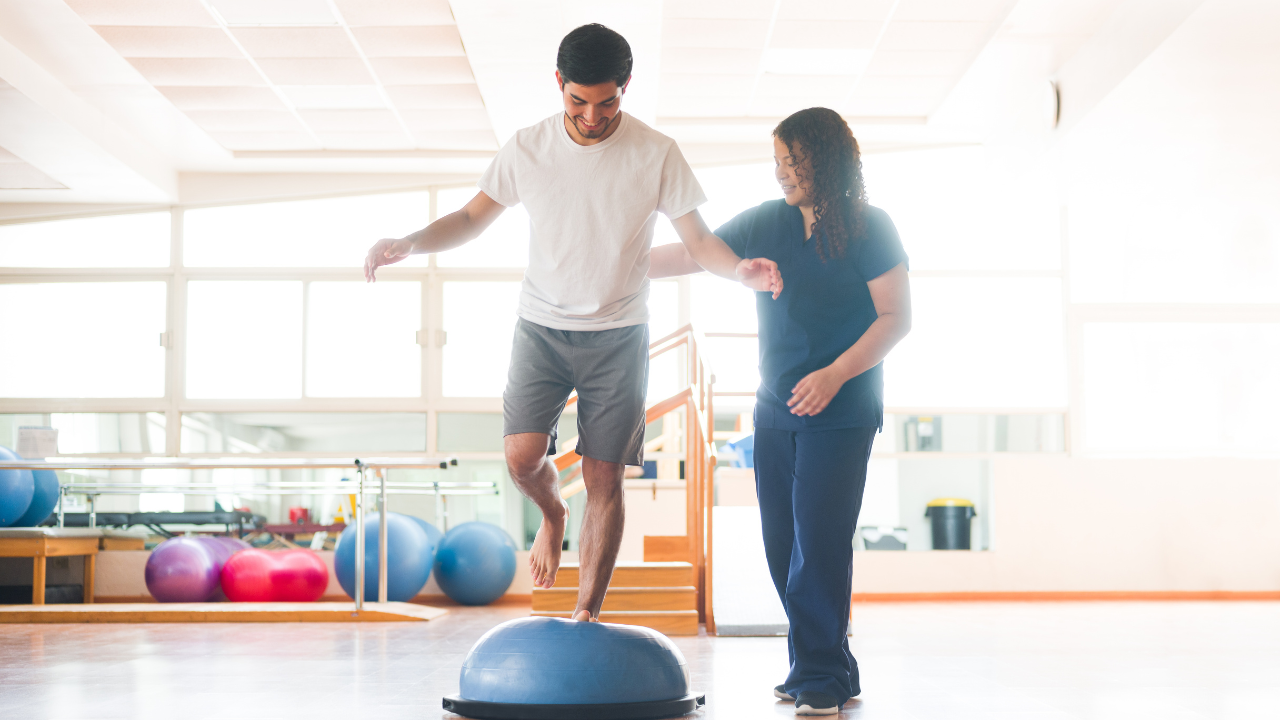
This usually reflects neuromuscular recovery rather than failure of the operation itself. The limb may still be weak. Landing mechanics may still be asymmetrical. The patient may hesitate during deceleration, turning or single-leg work. Confidence often lags behind healing.
This is why good ACL rehabilitation is not purely about strength in a gym-based sense. It is also about restoring timing, coordination, control and confidence under load.
A knee that is strong in a simple exercise is not necessarily ready for football, skiing, netball or rugby.
Running, Hopping and Return to Sport
Return to running and return to sport are not the same milestone.
Running generally comes first, once swelling is controlled, movement is restored and sufficient strength and load tolerance have been rebuilt. Hopping, deceleration and change-of-direction work come later and need to be layered in carefully.
For athletes and active individuals, this phase is often where rehabilitation becomes most valuable. The easy mistake is to assume that because the knee is less painful and basic strength is improving, sport is simply the next step.
But sport asks much more of the knee than daily life does.
It asks for repeated single-leg force absorption, rapid acceleration and deceleration, reactive balance, rotational control and confidence under pressure. These qualities need to be rebuilt progressively and tested properly.
Return to sport should be based on function, movement quality and confidence, not just the passage of time.
When Recovery Feels Slower Than Expected
Not every ACL reconstruction follows the same timeline.
Some knees settle quickly. Others remain reactive, stiff or difficult to progress for longer than expected. A slower recovery does not automatically mean something is wrong with the graft, but it does mean the knee needs proper assessment.
Sometimes the limiting factor is persistent swelling. Sometimes it is extension loss. Sometimes the quadriceps remain stubbornly inhibited. In others, the physical recovery is progressing reasonably well but confidence is lagging badly, especially in people hoping to return to demanding sport.
There are also cases where associated procedures, such as meniscal repair, make early progression intentionally slower.
Good rehabilitation is not about pushing everyone along the same path at the same speed. It is about recognising what is limiting progress in that particular knee and addressing it intelligently.
When Symptoms Need Further Investigation
Some pain, swelling and stiffness are expected after ACL reconstruction.
The important question is whether the knee is gradually progressing, even if slowly, or whether it is moving in the wrong direction.
Increasing redness, wound problems, marked calf swelling, chest symptoms, fever, worsening pain or a clear decline in function need medical review. Persistent motion loss or an unexpectedly blocked, highly irritable knee may also need closer reassessment.
Part of specialist rehabilitation is knowing when to progress, when to consolidate and when further investigation is required.
Long-Term Outcome
A well-rehabilitated ACL reconstruction should allow the individual to return not only to everyday life, but to a high level of movement confidence.
That may mean running without hesitation. It may mean returning to football, skiing or court sport. It may mean trusting the knee again during gym work, hills, trails or fast direction changes.
The operation creates the possibility of that outcome.
Rehabilitation is what makes it real.
Related Knee Conditions
Some patients undergoing ACL reconstruction first present with the instability, swelling and giving-way episodes described on our ACL injury→ page. Others have associated meniscal tears and knee cartilage injury→ at the time of their original injury, which can influence both surgery and rehabilitation. During recovery, some patients also develop more anterior knee symptoms consistent with patellofemoral pain→, particularly where quadriceps weakness and altered movement patterns remain prominent.
Specialist Post-Operative ACL Rehabilitation
Post ACL rehabilitation forms part of our specialist knee service. Assessment looks not only at the operated knee itself, but at gait quality, strength recovery, pelvic control, balance, stair function, soft tissue irritation and the overall confidence with which the individual is returning to daily life after surgery.
Our aim is to help patients recover not only a well-healed knee, but a knee that functions as well as possible in the real world.
You can explore our full knee assessment and rehabilitation pathway here→
Frequently Asked Questions About ACL Reconstruction Rehabilitation
How long does ACL reconstruction recovery take?
Why is it so important to get my knee straight early on?
Is swelling normal after ACL reconstruction?
When can I start running again?
When can I return to sport?
Why does my knee still feel weak if the ligament has been reconstructed?
Why does the knee still feel unstable sometimes?
Can I have a good operation but still a disappointing result?
What if I had meniscus surgery as well?
Can physiotherapy still help if I am months after surgery?
Book a Specialist Knee Assessment
If you are recovering from ACL reconstruction and want structured, specialist rehabilitation focused on strength, control and confident return to activity, appointments are available within our specialist knee service.
Assessment is detailed, individualised and focused on helping the knee function as well as possible in the real world.
Appointments are available within our specialist knee clinics in Gosport, Emsworth and Clanfield. Book online or contact us→
Book your specialist knee appointment online